Home » Articles posted by M. Adil Hussain (Page 6)
Author Archives: M. Adil Hussain
Khalid Petiwala Notes for CAF
Here we are sharing the most valuable exam material source for the CAF students for the following papers of Honorable Mr. Khalid Petiwala:
GOODS EXEMPT FROM SALES TAX (SEC-13)
GOODS EXEMPT FROM SALES TAX (SEC-13)
- Supply of goods or import of goods specified in the Sixth Schedule shall, subject to such conditions as may be specified by the Federal Government, be exempt from tax under Sales Tax Act. The provisions of section 13 shall apply notwithstanding anything contained in section 3.
- The Federal Government may, pursuant to the approval of the Economic Coordination Committee of Cabinet exempt any taxable supplies made or import or supply of any goods or class of goods from the whole or any part of the tax chargeable under the Sales Tax Act. This exemption shall be notified in the official Gazette and shall be subject to such conditions and limitations as specified in the notification.
- Exemption from tax chargeable under above second paragraph above may be allowed from any previous date specified in the notification issued or order made.
- The Federal Government shall place before the National Assembly all exemptions related notifications issued during the financial year.
- Any notification issued above, if not earlier recommended stand rescinded on the expiry of financial year in which it has issued.
ZERO RATING AND EXEMPTION
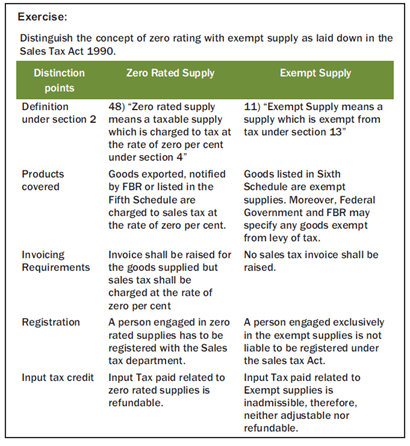
GOODS CHARGED TO TAX @ 0%
_ Value of following goods shall be charged to tax at the rate of zero percent:
- goods exported, or the goods specified in the Fifth Schedule;
- supply of stores and provisions for consumption aboard a conveyance proceeding to a destination outside Pakistan as specified in section 24 of the Customs Act, 1969; and
- such other goods notified by the Federal Government in the Official Gazette.
- such other goods as may be specified by the Federal Board of Revenue through a general order as are supplied to a registered person or class of registered persons engaged in the manufacture and supply of zerorated goods.
Exception to the above rule
_ Provision relating to zero rating shall not apply in respect of a supply of goods which:
- are exported, but have been or are intended to be re-imported into Pakistan; or
- have been entered for export under Section 131 of the Customs Act, 1969, but are not exported; or
- have been exported to a country specified by the Federal Government, by Notification in the official Gazette.
_ Federal Government may, by a notification in the official Gazette, restrict the amount of credit for input tax actually paid and claimed by a person making a zero-rated supply of goods otherwise chargeable to sales tax.
Fifth Schedule is given hereunder:
| Sr. # | Description |
| 1. | (i) Supply, repair or maintenance of any ship which is neither;
(a) a ship of gross tonnage of less than 15 LDT; nor (b) a ship designed or adapted for use for recreation or pleasure. (ii) Supply, repair or maintenance of any aircraft which is neither (a) an aircraft of weight-less than 8000 kilograms; nor (b) an aircraft designed or adapted for use for recreation or pleasure. (iii) Supply of spare parts and equipment for ships and aircraft falling under (i) and (ii) above. (iv) Supply of equipment and machinery for pilot age, salvage or towage services. (v) Supply of equipment and machinery for air navigation services. (vi) Supply of equipment and machinery for other services provided for the handling of ships or aircraft in a port or Customs Airport. |
| 2. | Supply to diplomats, diplomatic missions, privileged persons and privileged organizations which are covered under various Acts, Orders, Rules, Regulations and Agreements passed by the Parliament or issued or agreed by the Government of Pakistan. |
| 3. | Supplies to duty free shops, provided that in case of clearance from duty free shops against various baggage rules issued under the Customs Act, 1969, (IV of 1969), the supplies from duty free shops shall be treated as import for the purpose of levy of sales
tax. |
| 4. | Supplies of raw materials, components and goods for further manufacture of goods in the Export Processing Zone. |
| 5. |
Supplies of such locally manufactured plant and machinery to petroleum and gas sector Exploration and Production companies, their contractors and sub-contractors as may be specified by the Federal Government, by notification in the official Gazette, subject to such conditions and restrictions as may be specified in such notification. |
| 6. | Supplies of locally manufactured plant and machinery of the
following specifications, to manufacturers in the Export processing zone, subject to the conditions, restriction and procedure given below, namely:- (i) Plant and machinery, operated by power of any description, as is used for the manufacture or production of goods by that manufacture, (ii) Apparatus, appliances and equipments specifically meant or adapted for use in conjunction with the machinery specified in clause (i) ; (iii) Mechanical and electrical control and transmission gear, meant or adopted for use in conjunction with machinery specified in clause (i) ; and (iv) Parts of machinery as specified I clauses (i), (ii) and (iii) identifiable for use in or with such machinery. Conditions, restrictions and procedures:- (a) The supplier of the machinery is registered under the Act: (b) Proper bill of export is filed showing registration number; (c) The purchaser of the machinery is an established manufacturer located in the Export processing zone and holds a certificate from the Export processing zone and holds a certificate from the Export processing zone Authority to that effect; (d) The purchaser submits and indemnity bond in proper form to the satisfaction of the concerned commissioner inland Revenue that the machinery shall, without prior permission from the said commissioner, not be sold, transferred or otherwise moved out of the Export processing zone before a period of five years from the date of entry into the Zone; (e) If the machinery in brought to tariff area of Pakistan, sales tax shall be charged on the value assessed on the bill of entry; and (f) Breach of any of the conditions specified herein shall attract legal action under the relevant provisions of the Act, besides recovery of the amount of sales tax along with default surcharge and penalties involved.”; (g) Against serial number 9, in column (2), the word “who makes local supplies of both taxable and exempt goods” shall be omitted; (h) Against serial number 12, in column (2), in clause (ix), the words “including flavored milk” and the word and figure “and 0402.9900” shall be omitted; and thereafter clauses (x) to (xvi) shall be omitted; |
| 7. | Supplies made To exporters under the Duty and Tax Remission Rules, 2001 subject to the observance of procedures, restrictions and conditions prescribed therein. |
| 8. | Imports or supplies made to Gawadar Special Economic Zone, excluding vehicles falling under heading 87.02 of the Pakistan Customs Tariff, subject to such conditions, limitations and restrictions as the Board may impose. |
| 9. | Petroleum Crude Oil. |
| 10. |
Goods exempted under section 13, if exported by a manufacturer who makes local supplies of both taxable and exempt goods. |
JOINT AND SEVERAL LIABILITY OF REGISTERED PERSONS IN SUPPLY CHAIN WHERE TAX UNPAID (SEC-8B)
JOINT AND SEVERAL LIABILITY OF REGISTERED PERSONS IN SUPPLY CHAIN WHERE TAX UNPAID (SEC-8B)
_ Where a registered person receiving a taxable supply from another registered person is in the knowledge or has reasonable grounds to suspect that some or all of the tax payable in respect of that supply or any previous or subsequent supply of the goods supplied would go unpaid of which burden to prove shall be on the department, such person as well as the person making the taxable supply shall be jointly and severally liable for payment of such unpaid amount of tax.
_ Provided that the Board may by notification in the official gazette, exempt any transaction or transactions from the provisions of this section.
COLLECTION OF EXCESS SALES TAX (SEC-3 B)
COLLECTION OF EXCESS SALES TAX (SEC-3 B)
_ Any person who has collected or collects any tax or charge, whether under misapprehension of any provision of this Act or otherwise, which was not payable as tax or charge or which is in excess of the tax or charge actually payable and the incidence of which has been passed on to the consumer, shall pay the amount of tax or charge so collected to the Federal Government.
_ Any amount payable to the Federal Government shall be deemed to be an arrears of tax or charge payable under this Act and shall be recoverable accordingly and no claim for refund in respect of such amount shall be admissible.
_ The burden of proof that the incidence of tax or charge has been or has not been passed to the consumer shall be on the person collecting the tax or charge.
| Exercise :
Hassan (Pvt.) Ltd. under misapprehension collected additional sales tax of Rs. 100,000 from one of its customers. 65% of the goods on which additional sales tax was collected are still lying with the customer as unsold stock. |
| Answer :
In the above scenario, since 65% of the stock, on which excess tax of (100,000 x 65%) Rs. 65,000 was collected, is still unsold, Hassan Ltd should return this amount to its customer. However, the balance amount of Rs. 35,000, the incidence of which has been passed on to the consumers should be deposited with the Federal Government. |
WHO IS LIABLE TO PAY SALES TAX ?
LIABILITY TO PAY SALES TAX
The liability to pay the tax shall be:
(i) In the case of supply of goods in Pakistan, of the person making the supply, and
(ii) In the case of goods imported into Pakistan, of the person importing the goods.The Federal Government may specify the goods in respect of which the liability to pay tax shall be of the person receiving the supply.
SCOPE OF SALES TAX
WHAT IS THE SCOPE OF SALES TAX ?
It is very important question for a person studying SALES TAX ACT 1990, either for practice or for preparation of Examinations. Here we are going to share with you the scope of SALES TAX in Pakistan in nutshell.
Hope it will be helpful for you both in examinations and practice.
Normal rate of sales tax
– Sales tax @ 17% is charged, levied and paid on the value of:
(i) taxable supplies made by a registered person in the course or furtherance of any taxable activity carried on by him; and
(ii) goods imported into Pakistan.
– Where the taxable supplies are made to a person who has not obtained registration number, there shall be charged, levied and paid a further tax at the rate of 2% of the value in addition to the normal rate of 17%.
– However Federal Government may, by notification in the official Gazette specify the taxable supplies in respect of which the further tax shall not be charged, levied and paid.
– SRO 648(1)/2013 dated 9th July, 2013 provides following list of persons on which this further tax @ 1% is not charged, levied or paid on the taxable supplies of:
(i) Electricity energy supplied to domestic and agricultural consumers.
(ii) Natural gas supplied to domestic consumers.
(iii) Motor oil, diesel oil, jet fuel, kerosene oil and fuel oil.
(iv) Goods sold by the retailers to end customers.
(v) Supply of goods directly to end customers including food, beverages, fertilizers and vehicles.
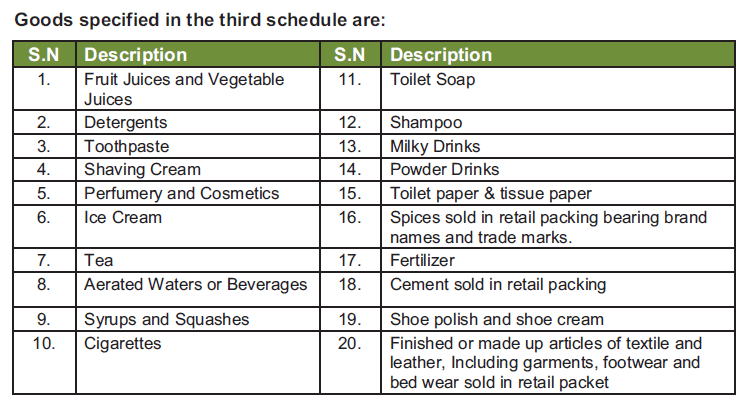
(vi) Items listed in Third Schedule to the Sales Tax Act, 1990.
Tax on taxable supplies specified in third schedule [Section 3(2)(a)]
– Sales Tax @17 % will be charged on the retail price on the goods specified in Third Schedule.
– The manufacturer shall legibly, prominently and indelibly print or emboss retail price along with the amount of sales tax on the packet, container, package, cover or label etc.
– Federal Government, may exclude from or include into said schedule any taxable supply by notification in the official Gazette.
Special rates of tax [Section 3(2)(b)]
The Federal Government is empowered to prescribe any higher or lower rate of tax in respect of any class of taxable goods.
Extra tax [Section 3(5)]
Federal Government is empowered to levy and collect tax at such extra rate or amount not exceeding 17% in addition to the amount of sales tax or retail tax, levied under Sales Tax Act, 1990. This tax shall be levied on the value of such goods or class of goods, on such persons or class of persons, in such mode, manner and at time and subject to such conditions & limitations as may be prescribed.
Capacity tax[Section 3(1B)]
Moreover the Board may levy and collect tax on the following instead of levying and collecting tax on taxable supplies:
a. production capacity of plants, machinery, undertaking, establishments or installations producing or manufacturing such goods; or
b. fixed basis, as it may deem fit, from any person who is in a position to collect such tax due to the nature of the business.
Tax on supply to CNG stations
– In case of supply of natural gas to CNG stations, the Gas Transmission and Distribution Company shall charge sales tax from the CNG stations at the rate of 17% on the value of supply to the CNG consumers.
– Value for the purpose of levy of sales tax shall include price of natural gas, charges, rents, commissions and all local, provincial and Federal duties and taxes but excluding the amount of sales tax
Special Powers to the Federal Government
The Federal Government or the Board is authorized to levy, in lieu of Sales Tax under section 3(1), by notification in the Official Gazette such amount of tax as it may deem fit on any supplies or class of supplies or any goods or class of goods. They are also authorized to specify the mode, manner or time of payment of such tax.
All PAC CFAP Mocks Winter 2016 Updated with solutions
Here is the related data for students appearing in ICAP CFAP Examination for Winter 2016.
SALES TAX
SALES TAX INTRODUCTION:
Here I would like to share with you the introduction to the sales tax laws applied in Pakistan.
Sales Tax Laws mainly include:
and some special rules include
Sales Tax Special Procedure Rules, 2007
Sales Tax Special Procedure (Withholding) Rules, 2007
Here are the useful notes on SALES TAX for better understanding of the above mentioned Laws.

TAXATION
Here we share the Video Lectures on Taxation Laws applicable in Pakistan.
Following is the List of Notes and Video Lectures;
1.2 Tax year as defined in ITO 2001
1.4- Scope of Income – Practice Questions
This material is equally useful for the understanding of the general public and more specifically my fellow students of Chartered Accountancy preparing for the following examination of Intermediate Stage CERTIFIED IN ACCOUNTING AND FINANCE (CAF) LEVEL and Final Stage CERTIFIED FINANCE AND ACCOUNTING PROFESSIONAL (CFAP) LEVEL under Institute of Chartered Accountants of Pakistan.
CAF 06 – PRINCIPLES OF TAXATION
CFAP 05 – ADVANCED TAXATION
This will provide basic knowledge in the understanding of objectives of taxation and core areas of Income Tax Ordinance, 2001, Income Tax Rules 2002 and Sales Tax Act 1990 and Sales Tax Rules.
Special Thanks to well known Chartered Accountant honorable Mr. Khalid Petiwal, a well-known Chartered Accountant, for such act of kindness.
 M. Adil Hussain
 Future Chartered Accountants